Knife Block Sets: The Complete Buying Guide
The right knife block set has the knives you use, a block that fits your counter, and a care routine you can follow. Start with a chef’s knife, paring knife and bread knife, then compare extras and sharpening options.
On this page (7 sections)
The right knife block set has the knives you use, a block that fits your counter, and a care routine you can follow. Start with a chef’s knife, paring knife and bread knife, then compare extras such as steak knives, shears and a sharpening steel.
A large piece count doesn’t guarantee a useful set. Think about what you cook, how you store knives and which sharpening tools you’re comfortable using.
For a closer look at the choices, see our guides to choosing a knife block set and which knives you need in a set.
What should a knife block set include?
A practical knife block set starts with a chef’s knife, paring knife and bread knife. Choose extras based on the food you prepare and how many people you serve.
| Knife or tool | Useful for | Consider it if |
|---|---|---|
| Chef’s knife | Chopping and general prep | You want one main all-purpose knife |
| Paring knife | Small fruit, vegetables and detail work | You often prep small ingredients |
| Bread knife | Slicing crusty bread and soft interiors | You regularly buy whole loaves |
| Santoku knife | Chopping and slicing | You prefer its shape or want another prep knife |
| Utility knife | Smaller slicing and trimming jobs | Your chef’s knife feels too large for some tasks |
| Steak knives | Cutting food at the table | You serve steak or want a matching table set |
| Kitchen shears | General kitchen cutting jobs | You want shears stored with your knives |
| Honing steel | Realigning a compatible blade’s edge | You’re comfortable using a honing steel |
Sets often count steak knives and tools toward the total. Compare the included pieces rather than relying on the number printed in a title.
For a more detailed checklist, use our guide to the knives you need in a set. It can help you avoid buying pieces that will sit untouched.
How many knives do you need in a knife block set?
Buy for the cooking jobs you do now, not an imagined collection. A small set may cover most everyday prep, while a larger one can make sense for a household that uses steak knives and several prep styles.
Consider whether the set includes duplicate-purpose knives. For example, a chef’s knife and santoku can both serve as main prep knives, so owning both is useful only if you want the choice.
A block also takes up counter space. If you only need a few knives, compare a smaller set or individual knives before choosing a large block.
What blade construction should you compare?
Forged and stamped describe different blade construction methods, but neither guarantees that a set is right for everyone. Compare the individual knife’s weight, handle and feel if you can, and consider the care each set calls for.
The Cuisinart set in this guide has forged construction, full-tang blades and an extra-wide bolster. The Henckels Statement set uses single-piece, precision-stamped blades, which Henckels describes as lightweight.
Those details can help narrow your options, but they don’t predict how a knife will feel in your hand. See forged vs stamped knives for a closer explanation.
Does high-carbon stainless steel matter?
High-carbon stainless steel is a material description, but the words alone don’t tell you how a specific knife will perform or feel. Compare the construction and care needs alongside the steel.
The Cuisinart and McCook sets have high-carbon stainless steel blades. Astercook uses 1.4116 high-carbon German stainless steel.
Avoid choosing by material label alone. Handle shape, construction, edge type, block design and care needs all matter to a buying decision.
Which block style fits your kitchen?
Choose a block that stores the knives you’ll use and fits the counter space you have. Measure the intended spot, including the clearance needed to remove knives without hitting cabinets.
A traditional block holds knives in individual slots. Some blocks also include a built-in sharpener, while others pair the knives with a separate honing steel.
Check the block’s material and dimensions before choosing. A wood block may need different cleaning and drying habits from the knives it stores.
Are built-in sharpeners convenient?
A built-in sharpener can make touch-ups convenient, but check blade compatibility and the instructions first. It doesn’t mean you can ignore blade care or use the sharpener on every knife.
McCook and Astercook include built-in sharpeners. McCook recommends hand washing for long-term rust prevention, and its set isn’t dishwasher safe.
Read the guidance for the set you choose, including any restrictions for serrated or coated blades. See whether self-sharpening knife blocks work for more context.
Which knife block set may suit your kitchen?
Choose Cuisinart for forged blades and a separate steel, Henckels for stamped blades and a bread knife, or McCook and Astercook for built-in sharpeners. Match the included tools to your routine, rather than choosing by piece count alone.
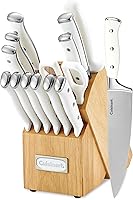
Cuisinart 15-Piece Forged Triple Rivet Set
This Cuisinart set may suit cooks who want a forged set with several prep knives, six steak knives and a wooden block. Its pieces include a chef’s knife, slicing knife, santoku, utility knife, two paring knives, sharpening steel and household shears.
The full-tang blades are secured to the handles with stainless steel rivets. Cuisinart says the extra-wide bolster is designed for stability and control.
Consider it if you want a broad mix of prep and table knives. It doesn’t include a bread knife, so account for that if you regularly slice whole loaves.
Henckels Statement 15-Piece Block Set
The Henckels Statement set may suit cooks who want stamped blades and a hardwood block. It includes an 8-inch chef’s knife, 8-inch bread knife, 7-inch hollow-edge santoku, paring and serrated utility knives, six steak knives, kitchen shears and a honing steel.
Henckels describes the knives as lightweight and dishwasher safe. Follow the care guidance supplied with your knives, including instructions for cleaning the block separately.
Consider it if a bread knife and separate honing steel suit your routine. Compare its included pieces with our Henckels knife set guide before deciding.
McCook 15-Piece Block Set With Sharpener
This McCook set may suit cooks who want a block with a built-in sharpener. Its tools include a chef’s knife, slicing knife, santoku, serrated and fine-edge utility knives, paring knife, six serrated steak knives and two pairs of shears.
McCook recommends hand washing for long-term rust prevention and says the set isn’t dishwasher safe. Its prep knives include a 5-inch santoku and a 5-inch fine-edge utility knife.
Consider it if you want those smaller prep knives and built-in sharpening. For a focused comparison, see McCook vs Henckels Statement.
Astercook 15-Piece Block Set With Sharpener
This Astercook set may suit cooks who want a black block with a built-in sharpener and a broad set of knives. It includes a chef’s knife, slicing knife, santoku, bread knife, utility and paring knives, six serrated steak knives and kitchen shears.
The knives have forged 1.4116 high-carbon German stainless steel blades with a black coating. Astercook describes the knives as dishwasher safe and backs the set with a lifetime warranty.
Consider it if you want a bread knife alongside built-in sharpening. Compare that combination with the separate steel and prep knives in the other sets here.
How should you compare knife block sets?
Compare the knives, block, sharpening tools and care instructions as one package. A set that matches your cooking routine is more useful than one that simply has more pieces.
Use this checklist while comparing options:
- List your regular prep tasks. Note whether you slice bread, prep small produce or serve steak often.
- Count the knives you expect to use. Look for overlap between similar-purpose knives.
- Check the block footprint. Measure the counter space and clearance around it.
- Review sharpening needs. See whether the set includes a steel or built-in sharpener.
- Read care instructions. Some knife sets call for hand washing, even if others allow dishwasher cleaning.
- Check what is covered by any warranty. Warranty terms vary by brand and set.
A comparison should reflect your kitchen, not a universal ranking. Our best knife block sets roundup can help you compare selected options.
How do you care for a knife block set?
Follow the care instructions for both the knives and the block. Keep blades clean and dry after washing, and avoid putting any knife in a dishwasher unless its care guidance allows it.
A damp block can trap moisture around stored blades. Return knives only when they’re clean and dry, and clean the block using a method suited to its material.
Sharpening and honing are different tasks, and a steel or built-in sharpener may not suit every blade. Check the set’s instructions before using either tool.
Read how to clean a knife block for storage and upkeep. If you need sharpening guidance, see how to sharpen knives in a knife block.
Which knife block set should you choose?
Choose Cuisinart if you want forged blades and a separate steel, or Henckels if you prefer stamped blades with a bread knife. McCook and Astercook suit shoppers who want a built-in sharpener, with different prep knives and care needs.
Before deciding, check for the knife you’d miss most, such as a bread knife, and measure the space needed to lift blades from the block. Continue with our guide to choosing a knife block set to narrow the details that matter in your kitchen.
Frequently asked questions
What knives should a basic knife block set include?
A useful starting set has a chef’s knife for everyday chopping, a paring knife for small jobs and a bread knife for crusty loaves. A utility or santoku knife can fill a specific gap, while steak knives make sense if you regularly serve steak.
Is a forged knife better than a stamped knife?
Neither construction is automatically better for every home cook. Forged and stamped describe how a blade is made, and weight and handling can differ by knife.
Compare the specific knife, handle, balance and care instructions you can live with. Our guide to forged vs stamped knives explains the trade-offs.
Are self-sharpening knife blocks worth it?
A self-sharpening block can make quick touch-ups easier, but it doesn’t remove the need to care for each knife. Check which slots sharpen, how the mechanism works and whether it suits the blade edges in the set.
Read our guide to self-sharpening knife blocks before choosing one.
How many knives do you need in a set?
Most cooks can cover daily prep with a chef’s knife, a paring knife and a bread knife. Add a santoku, utility knife or steak knives only if those jobs come up in your kitchen.
Compare the pieces you’ll use with the storage space you have.
How should you store knives in a block?
Store knives in slots that fit their blades, with the edges protected from contact with other utensils. Keep the block dry and clean, and follow the care instructions for both the knives and the block.
See our guide to cleaning a knife block for practical upkeep steps.