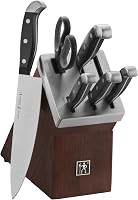
How to Sharpen Knives in a Knife Block
To sharpen knives in a knife block, remove each knife and use a compatible sharpener. A standard block only stores blades; use built-in sharpening slots only for the knives and motions specified by the block's instructions.
On this page (7 sections)
- Can you sharpen knives in a knife block?
- Does your knife need honing or sharpening?
- How do you sharpen a knife after taking it out?
- Which sharpener suits the knives you already have?
- What mistakes remove too much metal or damage an edge?
- How do you protect the edge after sharpening?
- Which tool should you choose for knives stored in a block?
To learn how to sharpen knives in a knife block, start by removing each knife and matching it to a suitable tool. A standard wooden or plastic block stores blades; its slots don't sharpen them.
You usually don't need a new knife set because a few blades have become dull. First separate routine honing from sharpening, then check whether each blade has a straight edge, serrations, or a special bevel.
Can you sharpen knives in a knife block?
You can use a block for sharpening only if it has a built-in system designed for that purpose. Ordinary storage slots provide no edge care, regardless of how often you insert or remove a knife.
Follow the block's directions for which slots sharpen, which knives belong in them, and how to move the blades. Don't assume every slot contains an abrasive or that serrated steak knives belong in sharpening slots.
If you can't identify the system, check its manual before using it. Our guide to how self-sharpening knife blocks work explains the difference between storage and edge maintenance.
Replacing the block is optional. Compare self-sharpening knife block sets only if you also want different knives or a storage system with built-in edge care.
Does your knife need honing or sharpening?
Hone a compatible edge for routine maintenance; sharpen it when honing stops helping. A steel honing rod mainly straightens a rolled edge, while sharpening removes metal to form a new cutting edge.
Try ordinary food prep on a stable board: a dull knife may slide on tomato skin or crush herbs instead of cutting cleanly. Never check sharpness by running a finger along the blade.
Inspect the knife first. Chips, a bent blade, or a loose handle call for advice from the manufacturer or a qualified knife service, rather than harder honing.
How do you hone knives from a knife block?
Remove one knife at a time and use the angle recommended for that blade. For a tip-down method, place the rod on a stable, nonslip surface and keep your supporting hand behind its guard.
Make slow strokes that cover the edge from heel to tip, alternating sides as directed. Avoid fast, sweeping motions near your body.
The Utopia 12-Inch Honing Rod suits cooks who maintain compatible kitchen knives regularly and can hold a steady angle. Its carbon steel body has nickel-chrome plating, with an ergonomic handle, slip-resistant rubber bottom, and hanging loop.
Skip it as your only tool for persistently dull blades: a honing rod isn't a full sharpening system. Also check your knife's care directions before using steel on a hard or specialty blade.
Utopia recommends wiping the rod with a non-woven cloth moistened with cooking oil, then drying it. After washing with water, dry it completely and hang it to air-dry in a cool place; keep it out of the dishwasher.
How do you sharpen a knife after taking it out?
Use light pressure, a compatible tool, and the knife's recommended edge angle. The exact motion depends on the sharpener, so follow its directions rather than copying a technique meant for another design.
- Prepare the counter. Clear space for the whole blade, dry the surface, and keep other knives stored.
- Clean and inspect the knife. Remove food residue and check for damage before starting.
- Confirm compatibility. Check the edge type, bevel, and any restrictions in the knife's care instructions.
- Secure the tool or blade. Position the handle, base, or clamp as directed before making a stroke.
- Start gently. Use the least aggressive suitable stage, then check the edge before continuing.
- Finish and clean. Complete the recommended fine stage, wash away residue, and dry the knife before storage.
For a slotted sharpener, use the stated stroke direction. Don't saw back and forth unless its instructions specifically call for that motion.
With a guided system, secure the knife before setting the angle. Check that the blade stays firm and that the abrasive can reach the edge without hitting the clamp.
Which sharpener suits the knives you already have?
Choose by edge type and how much control you want. A simple manual tool suits quick maintenance of compatible knives, while an adjustable guide suits cooks willing to spend more time setting up each blade.
Check unusual knives separately, including single-bevel blades and heavily curved edges. A tool that accepts your chef's knife may still be wrong for the bread knife beside it.
AccuSharp: for straightforward manual sharpening
The AccuSharp Knife Sharpener suits cooks who want a compact tool without a clamp or a sequence of separate knife stages. It uses coarse, diamond-honed tungsten carbide sharpening blades and has a handle for either hand.
Its supported knife types include chef's, paring, fillet, serrated knives, and cleavers. For serrations, follow AccuSharp's specific method rather than treating the edge like a straight blade.
Skip it if you want selectable angles or a fine finishing sequence. Coarse sharpening removes metal, so stop once the edge improves rather than adding passes as a habit.
The sharpening blades are reversible, and the tool can be cleaned with soap and water or in a dishwasher. Its full-length finger guard helps shield your hand, but secure positioning still matters.
Work Sharp: for controlled angles and varied blades
The Work Sharp Precision Adjust Elite suits cooks who want to choose an angle and work through sharpening and finishing steps. Use the knife manufacturer's recommendation rather than selecting an angle solely because a blade is described as Japanese or Western.
The kit includes 320-grit and 600-grit diamond plates, a ceramic finishing rod, a conical ceramic rod for serrations, a tri-brasive attachment for curved blades, and a leather strop. These serve different tasks; you don't need every abrasive for every session.
Skip this system if you want the shortest possible setup or don't want to clamp each knife. Before sharpening, make sure the blade is secure and the guide reaches its full edge.
Amazon Basics: for straight edges and staged sharpening
The Amazon Basics 4-in-1 Knife Sharpener suits households maintaining straight-edge knives and scissors with one tool. Its coarse, medium, and fine knife stages provide a progression, but a slightly dull blade may not need the coarsest stage.
It has a nonslip silicone base and includes cut-resistant hand protection. Keep the base flat and your supporting hand clear of the stroke; protective gloves aren't cut-proof.
Skip it for serrated knives, including bread knives. Use the separate scissor slot only as directed, and rinse or apply soapy water after use to remove debris.
What mistakes remove too much metal or damage an edge?
Avoid unnecessary coarse sharpening, heavy pressure, and mismatched angles. More strokes don't automatically produce a better edge.
Don't run every knife through the same routine just because they share a block. A frequently used chef's knife may need attention while a rarely used utility knife still cuts well.
Serrations need their own approach. With a suitable conical rod, work on the individual scallops according to the tool's directions instead of grinding away the teeth.
Don't chase a new angle without a reason. Changing the bevel can require substantial metal removal, and a guided sharpener's available settings aren't recommendations for every blade.
Stop if a slot catches, a clamp loosens, or the tool moves. Reset the setup before continuing, and leave deep chips or major reshaping to a qualified service.
How do you protect the edge after sharpening?
Wash away sharpening residue and dry the blade before returning it to the block. Follow the knife's care instructions, including any limits on soaking or dishwasher use.
Keep the slots clean and dry too. Follow our guide on how to clean a knife block before putting clean blades into storage.
Use a slot that accepts the knife without force, and avoid dragging its edge against the opening. Never use a knife tip to scrape debris from a slot.
Cut on wood or a suitable plastic board rather than glass, stone, or a bare countertop. Use the spine, rather than the cutting edge, to move chopped food across the board.
If your block is crowded, a knife block set buying guide can help you compare storage layouts and knife counts. For a future replacement, how to choose a knife block set explains how to match the knives and storage to your kitchen.
Which tool should you choose for knives stored in a block?
For how to sharpen knives in a knife block, choose the tool for the edge problem, not the storage style. Keep a compatible honing rod for upkeep, and add a sharpener when the edge needs more than realignment.
Choose Utopia for routine honing, AccuSharp for simple manual sharpening of compatible blades, or Work Sharp for adjustable angles and separate finishing tools. Choose Amazon Basics if your sharpening needs center on straight edges and scissors.
Start with the knife you use most, then assess the others individually. If storage also needs changing, use the complete knife block set guide to plan a block that fits your actual knives.
Frequently asked questions
Can you sharpen a knife while it is in a knife block?
A standard knife block cannot sharpen a knife, so remove the blade and use a compatible tool. Self-sharpening blocks have built-in sharpeners for designated slots and knives.
Follow the block's directions rather than repeatedly sliding every blade in and out, especially bread knives and other serrated blades.
Does a honing rod sharpen a knife?
A steel honing rod mainly straightens an edge that has rolled during use, though it can also remove some metal. It helps maintain compatible knives between sharpenings.
If careful honing does not improve cutting, switch to a suitable sharpener rather than adding pressure or making endless passes.
How often should I sharpen kitchen knives?
Sharpen when ordinary cutting stays difficult after appropriate honing, rather than following a fixed calendar. Frequency depends on use, blade steel, cutting boards, and storage.
A knife that slips on tomato skin or crushes herbs may need attention, but inspect for damage before choosing a tool.
Can you use a pull-through sharpener on every knife?
No, a pull-through sharpener must match the knife's edge type and bevel. Some accept straight edges only, while others provide directions for serrations.
Check compatibility before using one on a single-bevel or specialty knife, and do not assume a slot can safely reshape a chipped blade.