Forged vs Stamped Knives: Does It Matter? (October 2026)
Forged vs stamped knives differ in how their blades are formed: forged blades are shaped from heated steel, while stamped blades are cut from steel sheet. Choose by grip, blade shape and useful pieces, rather than construction alone.
On this page (11 sections)
- What is the difference between forged and stamped knives?
- Are forged knives heavier or better balanced?
- Which set suits a cook who wants fewer knives?
- Which forged block suits a coordinated kitchen?
- Which stamped block suits varied meal prep?
- How should you compare useful knives instead of piece counts?
- How do you set up forged or stamped knives for daily use?
- Which construction is easier to clean and sharpen?
- What buying mistakes should you avoid?
- Is forged construction worth paying more for?
- Forged vs stamped knives: which should you buy?
Forged vs stamped knives differ in how their blades are formed, but the better buy depends on grip, blade shape and the knives you'll use. Forged blades are shaped from heated steel; stamped blades are cut from steel sheet.
For most home cooks, the useful question is which knife makes daily prep comfortable and controlled. A construction label can't tell you whether a handle fits your hand or whether a large block contains pieces you need.
The 3 sets below show the practical choices: a focused forged collection, a coordinated forged block and a stamped block with more specialized blades.


What is the difference between forged and stamped knives?
Forged and stamped describe the blade-making process, not a complete quality grade. Steel choice, heat treatment, grinding and sharpening also affect the finished knife.
Forging shapes heated steel under force. Stamping cuts the blade outline from sheet steel before further shaping and finishing.
Forged knives often have thicker sections near the handle, while many stamped designs use thinner blades. These are common patterns, so check the individual knife rather than assuming either label guarantees a certain thickness.
What do forged vs stamped knives tell you about cutting?
Blade geometry matters more directly than the construction label when a knife moves through food. A thick blade can wedge in dense vegetables, while a thinner blade may pass through with less resistance.
Edge sharpness matters too: a dull knife needs more force regardless of how it was made. Forging doesn't remove the need for sharpening, and stamping doesn't mean a blade can't hold a useful edge.
Don't confuse thinness with permission to bend or pry. Kitchen knives are cutting tools, and twisting either type through hard food can damage the edge.
Does full tang mean forged?
Full tang and forged are separate features. Full tang means the blade steel extends through the full length of the handle; it doesn't identify how the blade was formed.
A full tang can add weight through the handle, but it doesn't guarantee a balance you'll enjoy. Handle shape and blade dimensions still affect control.
Likewise, rivets describe how handle parts are secured. They aren't a shortcut for judging edge quality or how easily a knife will cut.
Are forged knives heavier or better balanced?
Forged knives aren't automatically better balanced, and total weight alone doesn't tell you how tiring a knife will feel. Balance depends on where that weight sits relative to your grip.
A blade-heavy knife may suit someone who likes a firm, substantial feel during chopping. Another cook may prefer less weight for repeated slicing or longer prep sessions.
The Professional S chef's knife weighs 257 g, making it worth particular attention if you're seeking a light knife. Don't use the total shipping or set weight to judge how an individual blade will feel.
If you can hold a knife before buying, keep your wrist relaxed and notice whether you have to squeeze to steady it. Check for pressure points and enough room for your knuckles above the board.
Does a bolster or finger guard help?
A bolster can support your grip, but its shape also affects sharpening access. A bolster that reaches the cutting edge can make the heel harder to sharpen evenly.
The Professional S includes an integrated finger guard. It provides a physical boundary near the blade, but you still need dry hands, a stable board and fingers kept clear of the edge.
For a pinch grip, gently hold the blade just ahead of the handle with your thumb and forefinger. If that area feels awkward or presses into your hand, a different handle and blade junction may suit you better.
Which set suits a cook who wants fewer knives?
The Zwilling Professional S 3-Piece Set suits cooks who want core prep blades without a countertop block. It's the focused choice here for someone replacing a few knives rather than furnishing the whole kitchen at once.
It includes a 10 cm paring knife, 16 cm slicing knife and 20 cm chef's knife. The chef's knife handles board work, the paring knife handles small trimming jobs, and the slicer serves larger pieces of meat.
The set uses one-piece precision-forged steel and FRIODUR ice-hardened blades. ZWILLING describes the plastic handles as ergonomic and non-slip, and recommends hand washing.
Choose this set if you already have a bread knife or prefer to add specialty blades as needs arise. It also lets you choose a drawer insert, edge guards or another storage method instead of committing counter space to a block.
Skip it if you need a complete starter collection, table knives or storage included. Its slicer doesn't replace a serrated bread knife for crusty loaves, so bread-heavy households should plan for that gap.
Which forged block suits a coordinated kitchen?
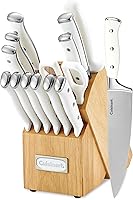
The Martha Stewart 16-Piece Block Set suits households that want prep knives and table knives stored together. Its linen white handles, gold accents and acacia wood block make appearance a clear part of the choice.
The prep selection includes an 8-inch chef's knife, 8-inch bread knife, 7-inch santoku, 5-inch utility knife and 3.5-inch paring knife. It also includes 8 steak knives, a sharpening rod and kitchen shears.
The blades use forged, full-tang high carbon stainless steel construction with triple-riveted ABS handles. The set is hand wash only, so choose it with that daily routine in mind.
Buy it if you'll use the table knives and want a choice between a chef's knife and santoku for board work. Those 2 shapes overlap, so you don't need to use both during every meal.
Skip it if you want only essential prep blades or don't have a permanent place for the block. A coordinated finish is a reasonable preference, but it shouldn't outweigh comfortable handling and useful contents.
Which stamped block suits varied meal prep?
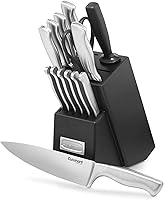
The Zwilling TWIN Gourmet 18-Piece Block Set suits cooks who want specialized prep knives alongside everyday blades. It gives you more task-specific choices than the small Professional S set.
Its prep knives include an 8-inch chef's knife, 8-inch bread knife, 6-inch utility knife, 5-inch serrated utility knife, 4-inch paring knife, 2.75-inch peeling knife and 5.5-inch boning knife.
The collection also includes 8 steak knives, shears, a honing steel and a hardwood block. Its blades use stamped German stainless steel, and ZWILLING describes the triple-riveted handles as ergonomic.
Choose it if you trim meat, peel small produce and want both serrated and straight utility blades. The boning knife gives you a narrower shape for working around bones, rather than asking a broad chef's knife to do every job.
Skip it if specialty knives would sit unused or you mainly prepare simple vegetable meals with one chef's knife. A longer contents list adds value only when those shapes solve tasks you actually do.
How should you compare useful knives instead of piece counts?
Count cutting tasks before counting pieces. A block, rod and shears contribute to a set's total, while several steak knives serve the table rather than food prep.
Write down what you cooked during a typical week. Match chopping to a chef's knife, crusty bread to a serrated blade, and small trimming jobs to a paring knife.
Then identify genuine gaps. A second utility knife may be useful in a shared kitchen, but less helpful to someone who already reaches for the same blade for every meal.
Our guide to choosing a knife set explains how to compare steel, contents and storage. For a shorter task-based checklist, read what knives you need in a set.
Storage should be part of that count. A compact collection still needs protected edges, while a block needs enough clearance to withdraw its longest knife without hitting an upper cabinet.
How do you set up forged or stamped knives for daily use?
Start with a stable cutting board and safe storage, whichever construction you choose. Wood or suitable plastic boards are better everyday cutting surfaces than glass, stone or ceramic, which can dull edges quickly.
Wash and dry new knives before putting them away. Set the board on a nonslip surface, or place a damp cloth underneath if it slides on the counter.
Store knives so edges can't strike loose utensils. With a block, keep it within easy reach of the prep area while leaving space to remove and return each knife safely.
Use a chef's knife for controlled slicing and chopping, and keep your guiding fingertips tucked back. Move chopped food with a bench scraper or the spine of the knife rather than dragging the cutting edge sideways.
Leave frozen food, bones and twisting cuts to tools designed for those jobs. Extra weight or forged construction doesn't turn a kitchen knife into a cleaver or pry bar.
Which construction is easier to clean and sharpen?
Both constructions need clean, dry storage and regular edge care. Stainless steel resists corrosion, but that doesn't make prolonged soaking or damp storage a good routine.
Wash knives individually with mild dish soap, keeping the edge pointed away from your fingers. Dry them promptly, and never leave a knife hidden under water or mixed into a sink of dishes.
The TWIN Gourmet set is described as dishwasher safe. Hand washing still reduces contact with other utensils and lets you dry each blade immediately.
Is honing the same as sharpening?
Honing and sharpening do different jobs. Honing generally helps realign an edge, while sharpening removes metal to restore its cutting shape.
A rod isn't a reason to press harder or make fast, uncontrolled strokes. Follow the tool's directions and use an angle suitable for the knife rather than guessing.
For a set-based maintenance routine, see how to sharpen knives in a knife block. Don't use a serrated bread knife in a sharpening slot unless the sharpener specifically supports that edge.
Keep crumbs and moisture out of storage slots, and return only dry knives. Our guide to cleaning a knife block covers the storage side of that routine.
For the broader routine, see our knife care and sharpening guide.
What buying mistakes should you avoid?
Don't pay for the forged label while overlooking fit, contents or upkeep. A knife that's awkward in your hand remains awkward even with construction features you wanted on paper.
Avoid assuming heavier means better. Some cooks like weight behind a cut; others gain control from a lighter tool they can guide without gripping tightly.
Don't treat sharpness out of the box as permanent. Every frequently used kitchen edge needs maintenance, and harder pressure is a cue to address the edge rather than force the cut.
Skip oversized collections bought for rare tasks. If you won't use table knives or specialized prep shapes, put more attention into the few blades you'll reach for daily.
Finally, don't choose a block before checking its location. Measure the space and withdrawal clearance, especially beneath cabinets, instead of assuming an empty corner will work.
Is forged construction worth paying more for?
Pay more for a particular knife's useful design, rather than forging alone. A comfortable handle, suitable blade shape and manageable care routine can justify a choice more clearly than the manufacturing label.
Separate immediate needs from future additions. A small set can be enough if it covers your prep and you already have safe storage; a block can make sense when several household gaps need filling together.
Compare the whole setup you'll use, including storage and edge maintenance. Buying extra blades doesn't remove either of those needs.
Forged vs stamped knives: which should you buy?
Choose Professional S for a focused prep collection, Martha Stewart for a coordinated forged block, or TWIN Gourmet for varied knife shapes. Those are more useful decision rules for forged vs stamped knives than assuming one construction always wins.
Pick the smaller collection when you want fewer tools and control over storage. Choose a block when its table knives, specialty blades and included storage all have a place in your kitchen.
If weight or grip is your main concern, resolve that before settling on construction. The right blade should let you work with a relaxed hand and controlled cuts.
For brand context, read Henckels vs Zwilling. If you're choosing between a block and separate storage, use our knife block set buying guide to make the final call.
Frequently asked questions
Are forged knives better than stamped knives?
Forged knives aren't automatically better than stamped knives. Steel, heat treatment, blade thickness, edge shape and handle fit all affect the finished knife.
Choose forged construction when the particular knife gives you the grip and cutting feel you want, rather than treating the label as proof of better performance.
Are stamped knives good for everyday cooking?
Stamped knives can handle everyday chopping, slicing and peeling. Choose the blade shapes you need and a handle you can control comfortably, then keep the edges sharp.
The Zwilling TWIN Gourmet set offers both common prep knives and specialized shapes, so it suits cooks who will use that range.
What is the main difference between forged and stamped knives?
The main difference is how the blade blank is formed: forged blades are shaped from heated steel, while stamped blades are cut from steel sheet. Both then need further work to become finished knives.
Neither method alone tells you the final blade thickness, sharpness, balance or handle comfort.
Does forged construction mean a knife has a full tang?
No, forged construction and full tang describe different features. Forging concerns how the blade is formed, while full tang means the steel extends through the full length of the handle.
The Martha Stewart set has both features, but you should check them separately on any knife you consider.
Which should I choose for a knife block set?
Choose the block set whose knife shapes and care routine match your household. The Martha Stewart set suits cooks who want a forged collection with coordinated handles, while the stamped TWIN Gourmet adds specialized prep blades.
Count useful knives first, then make sure the block fits your available counter space.