How to Choose a Knife Block Set: Pieces, Steel and Blocks
Choose a knife set by matching its useful pieces to your cooking, then compare blade construction, care needs and block storage. A larger piece count only helps if you’ll use what’s included.
On this page (5 sections)
Choose a knife set by matching its useful pieces to your cooking, then compare blade construction, care needs and block storage. A larger piece count only helps if you’ll use what’s included.
Start with the knives you reach for most: a chef’s knife for everyday prep, a paring knife for small tasks, and a bread knife or serrated utility knife for foods with a firm outside and soft center. Then decide whether steak knives, shears, a honing steel or a built-in sharpener solve a real need.
If you’re still deciding which blades belong in your kitchen, see what knives you need in a knife set. For a wider look at styles and trade-offs, read our knife block set buying guide.
How do you choose a knife set for your cooking?
Choose a knife set around the jobs you do every week, not the number printed on the box. A compact set can cover everyday prep, while a larger block may suit a household that needs steak knives and shared storage.
Write down the cutting tasks you do most often. That list can help you distinguish core knives from extras that would sit unused.
| Kitchen task | Useful knife or tool |
|---|---|
| Chopping vegetables and herbs | Chef’s knife |
| Peeling or trimming small produce | Paring knife |
| Slicing bread or tomatoes | Bread knife or serrated utility knife |
| Slicing cooked meat | Slicing knife |
| Cutting boneless ingredients or mincing | Santoku |
| Serving steak at the table | Steak knives |
| Opening packaging or trimming kitchen ties | Kitchen shears |
Sets use different piece-count conventions, so don’t compare the headline number alone. A set may count each steak knife as one piece, along with the block, shears or honing steel.
How to choose a knife set by its pieces
Choose the few knives that match your routine first, then count the accessories and extras. The knife set needs guide can help you narrow down which blades you’ll use.
A chef’s knife is a useful all-rounder for many home kitchens. A paring knife adds control for small work, while a bread knife or serrated utility knife can handle foods that are awkward to cut cleanly with a plain edge.
A santoku can fill a similar everyday role to a chef’s knife, but you may not need both. Choose the shape you prefer for your regular prep rather than treating an extra blade as an automatic upgrade.
Steak knives are useful when you serve steak or other foods that benefit from a table knife. If you rarely use them, a set with several steak knives may take up space without adding much value.
A honing steel is for maintaining an edge between sharpening sessions. It isn’t the same as a sharpener, so check what each included tool does before counting it as a useful extra.
What blade steel and construction should you compare?
Compare the blade material, edge care and construction, but don’t assume one label alone predicts how a knife will feel or perform. A set’s full combination of knives, handles and storage matters to the decision.
Stainless steel is used across these sets. The Cuisinart 15-Piece Forged Triple Rivet Set and imarku Japanese Block Set With Gyutou use high-carbon stainless steel, but that label alone doesn’t establish which set will suit your cooking.
Construction describes how blades are made. The Cuisinart 15-Piece Forged Triple Rivet Set is forged, while the Henckels Statement 15-Piece Block Set is stamped.
The Henckels set includes a 7 in santoku, an 8 in chef’s knife, an 8 in bread knife, six steak knives, shears and a honing steel. That selection may fit a kitchen that will use the extra blades and has room for its block.
Does a forged knife set make more sense than stamped?
Neither construction label makes a set the right choice by itself. Compare the pieces, handling features and storage setup along with construction.
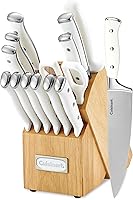
A forged set may appeal if that is a feature you specifically want. For example, the Cuisinart 15-Piece Forged Triple Rivet Set combines forged construction with a chef’s knife, slicing knife, santoku, utility knife and two paring knives.
It also includes six steak knives, shears, a sharpening steel and a wooden block. Count those accessories separately when deciding how much of the set you’ll use.
The Henckels Statement 15-Piece Block Set is stamped and includes a sharpening steel, shears and a hardwood block. If you want to understand the distinction before comparing these options, read how forged and stamped knives differ.
How should you choose a knife block?
Choose a knife block that fits your counter space and the pieces you intend to store. Its footprint and slots matter more than a high slot count if the knives won’t get used.
Measure the counter area where you expect to keep the block. Check whether you can reach the knives comfortably without crowding other work areas or placing the block where food prep happens.
Think about the knives included in the set and how you’ll store them. Don’t assume a smaller piece count means a smaller footprint, since block shapes and layouts vary.
Blocks can also house care tools or a built-in sharpener. The imarku Japanese Block Set With Gyutou includes a hardwood block with a built-in sharpener, while the Cuisinart 7-Piece Essentials Block Set pairs an acacia wood block with a built-in sharpener.
If your main concern is whether a block set fits your kitchen, our complete knife block set guide covers other factors to weigh.
Which knife sets illustrate different buying priorities?
These four sets show how you can compare knife selection, construction and sharpening tools. Choose by the combination that fits your kitchen and routine.
Cuisinart 15-Piece Forged Triple Rivet Set
The Cuisinart set includes an 8 in chef’s knife, 8 in slicing knife, 7 in santoku and 5.5 in utility knife. Its two paring knives measure 3.5 in and 2.75 in, with a bird’s beak blade on the smaller one.
It also comes with six 4.5 in steak knives, household shears, an 8 in sharpening steel and a wooden block. Its full-tang blades are secured to the handles with stainless steel rivets.
An extra-wide bolster is another part of the design. Consider the set if you want forged construction and expect to use most of the included pieces.
Henckels Statement 15-Piece Block Set
The Henckels set includes an 8 in chef’s knife, 8 in bread knife, 7 in hollow-edge santoku, 3 in paring knife and 5 in serrated utility knife. Six 4.5 in steak knives, kitchen shears, a honing steel and a hardwood block are also included.
Henckels describes the knives as dishwasher safe. Follow the care instructions, including any separate guidance for the wooden block.
The blades have single-piece, stamped construction and full tangs. This set may suit a kitchen that uses both a bread knife and a serrated utility knife.
imarku Japanese Block Set With Gyutou
The set includes an 8 in chef’s knife, 8 in bread knife, 8 in slicing knife, 7 in santoku, 5 in utility knife and 3.5 in paring knife. Six serrated steak knives and kitchen shears are also included.
Its hardwood block has a built-in sharpener. Follow imarku’s instructions for which blades to use with it, especially the serrated knives.
The knives are forged from high-carbon stainless steel, and imarku gives an edge angle of 10–15 degrees. If you’re considering a Japanese-style set, compare its blades and care setup with our guide to premium Japanese knives.
Cuisinart 7-Piece Essentials Block Set
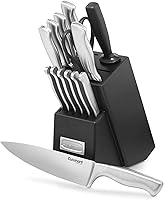
The Cuisinart Essentials set includes an 8 in chef’s knife, 8 in slicing knife, 7 in santoku, 5.5 in serrated utility knife and 3.5 in paring knife. Its acacia wood block has a built-in sharpener, and stainless steel shears are also included.
The knives have stainless steel blades and contoured stainless steel handles. Follow the sharpener instructions rather than assuming it suits every blade in the set.
This set skips steak knives and a honing steel. It may suit you if those omissions match how you cook and you want fewer pieces to store.
How can you narrow down your final choice?
Choose the set that fits your routine, care preferences and available storage. Start with useful knives, then check the block and any sharpening tool before comparing extras.
Use this short checklist before deciding:
- Name the 3 knives you’ll use most often.
- Check whether you need steak knives or kitchen shears.
- Decide whether you want a honing steel or a built-in sharpener.
- Compare blade construction and materials.
- Measure the space for the block.
- Check the care instructions for the set you’re considering.
If you want forged blades and steak knives, consider the Cuisinart 15-Piece Forged Triple Rivet Set. Choose the Henckels Statement 15-Piece Block Set if its bread knife and serrated utility knife better match your prep.
Consider the imarku Japanese Block Set With Gyutou if you want steak knives and a built-in sharpener. Choose the Cuisinart 7-Piece Essentials Block Set if you want five prep knives without steak knives.
To choose a knife set, use those differences to narrow your options before comparing extras. For more options built around different household needs, see our best knife sets for home cooks.
Frequently asked questions
How many knives do you need in a set?
Most home cooks can start with a chef’s knife, a paring knife and a bread knife or serrated utility knife. Choose a larger set if you’ll use its extra knives, steak knives or shears, and have room to store them.
Are forged knives better than stamped knives?
Forged and stamped describe how a blade is made, not a simple quality ranking. Compare the set’s pieces, handle and care needs, then choose the construction that fits your budget and preferences.
Our forged vs stamped knife guide explains the differences.
Should you buy a knife set with a built-in sharpener?
A built-in sharpener can make routine edge care more convenient, but check which knives it is designed to sharpen and follow the care instructions. A honing steel is different: it helps maintain an edge, while sharpening removes material to create a new one.
Is a knife block worth the counter space?
A block can keep knives together and within reach, but it uses counter space and may include more slots than you need. Measure the available area and compare the block’s footprint with drawer storage or a smaller set before choosing.