McCook Knife Set Review: Worth It? (October 2026)
Our McCook knife set review favors the McCook 15-Piece Block Set With Sharpener for cooks who want shared prep tools, table knives and convenient edge touch-ups. Skip it if you need dishwasher-safe knives or only a few kitchen blades.
On this page (8 sections)
- The McCook knife set reviews verdict
- Which McCook knives will you actually use?
- How should you choose between these knife sets?
- McCook vs. Cuisinart and Martha Stewart
- How do you set up the McCook block?
- How do you care for the knives and block?
- Which mistakes make a full knife set less useful?
- Which set should you choose after reading these McCook knife set reviews?
Our McCook knife set review favors this block for households that want prep knives, table knives and a nearby touch-up tool in one set. It makes less sense for cooks who want dishwasher cleanup or use only a chef knife and paring knife.
The main buying question is how many of its tools you'll use each week. A full block earns its counter space when it supports your cooking and meals, rather than holding several blades you rarely reach for.
For broader brand context, read Are McCook Knives Good?, then use our Henckels vs. McCook guide if you're choosing between those brands.
The McCook knife set reviews verdict
Choose McCook for a shared kitchen where several knife shapes and an easy-to-reach sharpener will get regular use. Skip it if your main need is a bread knife, dishwasher-safe cleanup or a smaller collection.
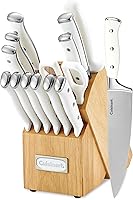
McCook 15-Piece Block Set With Sharpener

- 15-piece set
- Built-in block sharpener
- Forged full-tang blades
- Hand wash only
A practical choice for households that need prep knives and table knives together. The block keeps a touch-up tool close, but the knives need washing and drying by hand.
Pros
- Built-in sharpener for compatible blades
- Several prep knife shapes
- Six serrated steak knives
- Forged, full-tang construction
Cons
- Not dishwasher safe
- No dedicated bread knife among the included tools
- Overlapping prep knives may go unused
The forged, high-carbon stainless steel blades have full-tang construction, meaning the blade metal runs through the handle. That describes how the knives are built, but grip shape and weight still determine whether a knife feels comfortable in your hand.
McCook specifies a 15-degree edge and hardness of HRC 57±2. Those details don't establish how long an edge will last in your kitchen, since cutting surfaces, food and care all affect sharpness.
The strongest reason to buy is the combination of kitchen prep tools and table knives. If you're replacing a mixed collection with missing pieces, that coverage is useful; if your current knives already cover those jobs, a whole new block may add little.
McCook knife set review: what the built-in sharpener does
The sharpener is a manual touch-up tool, not an automatic action built into every storage slot. You pull a compatible blade through it when needed, following McCook's directions.
Keeping the tool beside the knives removes one step from routine care. It still matters how you use it: steady technique and the correct blade matter more than making extra passes.
Don't run the serrated knives through it unless McCook specifically permits that use. Their scalloped edges need an approach suited to their shape.
For the difference between built-in tools and automatic slot systems, read whether self-sharpening knife blocks work.
Which McCook knives will you actually use?
The chef knife and paring knife cover the broadest range of daily tasks, while the other shapes help with particular foods or preferences. Choose by those jobs, rather than the total piece count.
| Included item | Count or size | Typical use |
|---|---|---|
| Chef knife | 8 in | Chopping vegetables, mincing herbs and general prep |
| Slicing knife | 8 in | Cutting even slices from cooked boneless meat |
| Santoku knife | 5 in | Smaller batches of chopping and slicing |
| Serrated utility knife | 5.5 in | Tomatoes, rolls and other small foods with firm skins or crusts |
| Fine-edge utility knife | 5 in | Small slicing jobs that need more reach than a paring knife |
| Paring knife | 3.5 in | Peeling, trimming and detail work |
| Serrated steak knives | 6, 4.5 in | Individual table settings |
| Kitchen shears | 2 pairs | Food or packaging tasks suited to shears |
| Block | With built-in sharpener | Storage and edge touch-ups |
These components total 15 pieces, with the sharpener integrated into the block. The count includes storage and shears, so it doesn't mean you're getting 15 knives.
The chef knife and santoku overlap, but that can help when 2 people prepare different ingredients. A second prep blade is useful only if both cooks have room to work safely.
The smaller santoku may appeal if you prefer a shorter blade for modest portions. For a large cabbage or a wide cutting job, the chef knife gives you more length.
There is no dedicated bread knife in this selection. The serrated utility suits smaller foods, but its shorter blade isn't the same tool as a long bread knife for wide loaves.
Use our guide to the knives you need in a set to separate essential prep tools from pieces that mainly fill table settings.
How should you choose between these knife sets?
Match the set to your meals, grip preferences and care routine before comparing the number on the box. The most useful set is the one whose main knives suit the food you prepare.
Start with your usual meals
For weeknight vegetables and boneless proteins, a chef knife, paring knife and one smaller prep knife cover many tasks. Extra shapes become more useful when you carve cooked meat, prepare several dishes or share prep work.
Bread changes the choice here. If you regularly cut wide, crusty loaves, Martha Stewart's dedicated bread knife is a stronger reason to choose it than the difference in total pieces.
Match table knives to your household
Steak knives account for a large share of each set, so think about how many places you regularly set. Buying extra table knives brings little benefit if they stay in the block most of the year.
For a kitchen that already has suitable table cutlery, count only the prep knives as an upgrade. That prevents a large piece count from outweighing your actual needs.
Treat handle comfort as a separate choice
McCook and Cuisinart use stainless steel handles, while Martha Stewart uses ABS handles with rivets. Material alone doesn't tell you which shape will fit your palm or give you better control.
Keep hands and handles dry during use. If possible, assess a knife's grip and balance before committing to a whole set, especially if you dislike heavy handles or very slim grips.
Decide how you'll maintain the edges
A built-in pull-through tool suits someone who wants a fixed place for touch-ups. A separate steel suits someone willing to learn the angle and movement needed to use it well.
Our guide to choosing a knife block set explains how to weigh blade selection, construction and storage without getting distracted by piece counts.
McCook vs. Cuisinart and Martha Stewart
McCook is the convenience choice, Cuisinart suits cooks who prefer a steel, and Martha Stewart offers the clearest fit for bread and dinner hosting. Their different prep tools matter more than the small difference in set size.
| Set | Edge-care tool | Main reason to choose it | Main reason to skip it |
|---|---|---|---|
| McCook 15-Piece Block Set With Sharpener | Built into block | Shared prep and nearby touch-ups | You need a dedicated bread knife |
| Cuisinart 15-Piece Hollow Handle Block Set | Separate steel | Longer santoku and specialty paring blade | You don't want to learn steel technique |
| Martha Stewart 16-Piece Block Set | Separate rod | Bread knife and more table settings | You won't use the extra table knives |
Cuisinart: for cooks who want a steel and detail blade
Choose Cuisinart if its prep tools match jobs you already do. The 7-inch santoku gives you more blade length than McCook's version, while the bird's beak paring knife adds a curved tip for peeling and shaped cuts.
Cuisinart describes these hollow-handle knives as lightweight. That makes them worth considering if you prefer that style of handling, though it doesn't establish a weight comparison for every knife in these sets.
The included sharpening steel gives you a separate tool for routine edge care. A honing steel generally helps realign an edge; don't assume it will restore a damaged or deeply dull blade.
Cuisinart backs the set with a limited lifetime warranty against defects in materials and workmanship under normal home use for the original purchaser. Skip this option if the specialty blade would sit unused and you prefer McCook's simpler access to a touch-up tool.
Martha Stewart: for bread and larger table settings
Choose Martha Stewart if bread slicing and hosting are regular parts of your routine. Its 8-inch bread knife and eight steak knives give it a clear purpose beyond its coordinated appearance.
The forged, full-tang blades pair with triple-riveted ABS handles. Linen white and gold accents and an acacia block make this the strongest style-led choice among these options.
It requires hand washing, so the extra table knives also mean more individual cleanup after a meal. Skip it if you rarely serve that many people or would choose the finish despite preferring another set's prep tools.
How do you set up the McCook block?
Put the block on a dry, stable counter with room to lift every knife clear. Check the withdrawal path under cabinets, not just whether the set fits on the counter.
The set's overall dimensions are 14.3 x 8.7 x 6.1 inches. These aren't separate measurements of the block's base, so don't treat them as an exact countertop footprint.
Choose a spot away from sink splashes, counter edges and busy paths through the kitchen. Position it so you can reach a handle without stretching across a hot cooking area.
Before first use, wash and dry the knives according to McCook's directions. Learn where each shape belongs so you don't force a blade into the wrong slot.
If counter space is already tight, compare storage options in our knife block set buying guide before committing to another permanent countertop item.
How do you care for the knives and block?
Hand-wash the knives, dry them promptly and store them only when dry. McCook's set is not dishwasher safe, and stainless steel still benefits from protection against prolonged moisture.
Wash one knife at a time with mild dish soap, keeping the edge pointed away from your fingers. Don't hide sharp blades under soapy water or leave them loose in a sink.
Use a wooden or suitable plastic cutting board rather than glass, stone or a plate. Hard surfaces can damage an edge even when the blade material resists rust.
Move chopped food with a bench scraper or the spine of the knife instead of dragging the cutting edge sideways across the board. Avoid using kitchen knives to pry lids, twist through frozen food or cut bones.
Keep crumbs and moisture out of the block, and don't return a damp blade to its slot. Our knife block cleaning guide covers the storage care that is easy to overlook.
Which mistakes make a full knife set less useful?
Buying too many unused pieces and neglecting the main prep knife are the biggest mistakes. A large collection doesn't help if its everyday blade becomes awkward or dull.
Don't switch to a smaller knife simply because the chef knife struggles to start a cut. First check your cutting surface, technique and edge condition, since forcing a dull blade reduces control.
Don't sharpen on a fixed schedule just because the tool is nearby. Check how a clean blade cuts normal ingredients, then follow the care instructions when its edge needs attention.
Avoid treating forged construction or full tang as a promise of lasting comfort. Those features describe construction; they don't replace a grip that suits your hand or sensible use.
Which set should you choose after reading these McCook knife set reviews?
Buy McCook if the whole household will use its prep and table knives, and you want edge touch-ups close to where you store them. Keep your current knives if only one blade needs replacing.
Choose Cuisinart when a separate steel and curved paring blade match your routine. Choose Martha Stewart when you regularly cut bread and need more matching table settings.
Before ordering, make a short list of the knives you'll use during a normal week. If none of these sets matches that list, compare the best knife block sets for a better fit.
Frequently asked questions
Does the McCook knife set sharpen knives automatically?
No. McCook's built-in sharpener requires you to pull a compatible knife through it when the edge needs attention.
Returning a knife to its storage slot is a separate action. Follow McCook's directions for blade compatibility, pressure and passes, especially because serrated knives need a different approach.
What knives come in the McCook 15-piece set?
The set includes an 8-inch chef knife, 8-inch slicing knife, 5-inch santoku, 5.5-inch serrated utility knife, 5-inch fine-edge utility knife and 3.5-inch paring knife. Six serrated steak knives, two pairs of shears and the block complete the set.
The sharpener is built into the block.
Can you put McCook knives in the dishwasher?
No. This McCook set is not dishwasher safe and needs hand washing.
Clean each knife separately with mild dish soap, rinse it and dry it before storage. Avoid leaving knives in a sink or soaking the wooden block, where trapped moisture can cause problems.
How does McCook compare with Cuisinart's 15-piece set?
Choose McCook for its built-in touch-up sharpener, or Cuisinart if you prefer using a separate steel. Cuisinart also has a longer santoku and a bird's beak paring knife for curved detail cuts.
Both sets include six steak knives, so focus on prep tools and edge care.