Cuisinart vs Henckels Knives: Which Is Better? (October 2026)
For Henckels vs Cuisinart knives, choose Cuisinart for roast slicing and detailed prep, or Henckels for bread and sandwiches. Their specialty knives matter more to daily cooking than the shared 15-piece label.
On this page (9 sections)
- Henckels vs Cuisinart knives: what matters most?
- Which set has the more useful knives?
- Who should buy Cuisinart, and who should skip it?
- Who should buy Henckels, and who should skip it?
- How should you judge the piece count and block?
- How do you set up and use either set?
- Which set is easier to clean and maintain?
- What mistakes should you avoid when comparing these sets?
- Which should you buy: Henckels or Cuisinart?
Choose Cuisinart for roast slicing and detailed prep, or Henckels for bread and sandwiches. In this Henckels vs Cuisinart knives comparison, the strongest reason to choose either set is the work its specialty knives will do in your kitchen.
Both cover everyday chopping and include table knives and storage. Start with the meals you make, then consider blade construction, grip and upkeep.

Henckels vs Cuisinart knives: what matters most?
The knife mix matters more than the shared 15-piece label. Cuisinart favors slicing and small prep jobs, while Henckels gives you long and short serrated blades.
Think about your last week of meals. Carving boneless meat and peeling produce point toward Cuisinart; cutting crusty loaves, rolls and sandwich ingredients points toward Henckels.
If most meals involve chopped vegetables, herbs and simple proteins, either set covers the main tasks. In that case, your existing knives and preferred grip should break the tie.
Neither brand name establishes an edge-retention winner here. There is no shared steel-hardness or edge-angle information to support that conclusion.
What does forged versus stamped mean for Henckels vs Cuisinart knives?
Cuisinart uses forged construction; Henckels uses precision-stamped blades. Both have full tangs, meaning the blade steel extends through the handle.
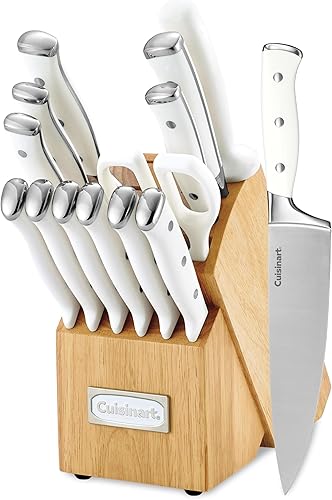
Cuisinart combines high-carbon stainless steel blades with riveted handles and an extra-wide bolster, the thick area where blade and handle meet. Cuisinart says that bolster supports stability and control.
Henckels describes Statement as lightweight, with curved, triple-rivet handles. That makes it a sensible candidate if you prefer easy maneuvering, although comfort still depends on your hand and grip.
Forged does not automatically mean sharper, and stamped does not automatically mean flimsy. Our guide to forged vs stamped knives explains which construction differences deserve attention.
Which set has the more useful knives?
Cuisinart suits slicing and peeling; Henckels suits bread and foods with firm skins and soft centers. Their shared core handles much of the same daily prep.
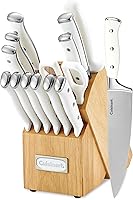
Both include an 8-inch chef's knife, a 7-inch santoku, six 4.5-inch steak knives, shears, a steel and a block. The chef's knife can handle most chopping, so don't assume every extra blade needs a separate daily role.
Cuisinart adds an 8-inch slicing knife, a 5.5-inch utility knife, a 3.5-inch paring knife and a 2.75-inch bird's-beak paring knife. Henckels adds an 8-inch bread knife, a 5-inch serrated utility knife and a 3-inch paring knife.
Henckels gives conflicting contents for this model: a smaller santoku appears in some descriptions but not others. Confirm the exact included knives before ordering if that extra blade matters to you.
Choose Cuisinart for slicing and small prep
Cuisinart's dedicated slicer makes sense if you regularly serve boneless roasts or cooked poultry breast. Use long, controlled strokes rather than pressing straight down, and keep the blade away from bones.
Its straight utility knife offers a middle size for jobs that feel awkward with a chef's knife. The curved bird's-beak blade suits peeling and trimming rounded produce, while the straight parer handles more general small cuts.
Those tools are useful when you already do that work. A curved paring knife adds little if you prefer a vegetable peeler and rarely trim fruit by hand.
Choose Henckels for bread and sandwich prep
Henckels' two serrated sizes suit different foods: the longer blade reaches across loaves, while the shorter one is easier to place on smaller rolls or tomatoes. Let the teeth start the cut with a gentle sawing motion.
The hollow-edge santoku has indentations that Henckels says help reduce food sticking. Food can still cling to a blade, so use a scraper or the knife's spine to clear it safely.
A bread knife also fills a gap that a straight slicer cannot replace neatly on every loaf. If homemade bread is a weekly habit, that is a stronger buying reason than construction style alone.
Who should buy Cuisinart, and who should skip it?
Buy Cuisinart if its slicing and paring tools fill real gaps. It is especially useful for a cook building a kitchen around family dinners, fruit prep and vegetable work.
The white finish may also suit a kitchen where the block stays on display. Treat that as a final preference after checking that you want the actual knife mix.
Skip this set if bread is your main unmet need and you want one block to cover it. Adding a separate bread knife means finding another safe storage spot.
Also skip it if you already own a good slicer and paring knife but need only a chef's knife. Replacing useful tools with duplicates can make a full set less practical than buying one knife.
Our Cuisinart 15-Piece set review takes a closer look at how this combination fits a home kitchen.
Who should buy Henckels, and who should skip it?
Buy Henckels if loaves, rolls and sandwiches are regular meals. Its serrated tools give it a clear role in a bread-focused kitchen.
It is also worth considering if you prefer the lighter handling Henckels describes. A cook who finds a substantial bolster awkward may prefer a different grip shape, but neither construction type guarantees comfort.
Skip Statement if you specifically want a dedicated slicer for serving meat. A chef's knife can slice boneless meat, but this set does not provide the separate slicing tool Cuisinart includes.
Skip either set if you have little counter space or need only a few prep knives. Six steak knives are helpful for table service, but they add little for someone who already has a full drawer of them.
For more detail, read our Henckels Statement set review. Our guide to Henckels knife sets can help if you want to compare other sets from the brand.
How should you judge the piece count and block?
Count useful jobs, not pieces. Blocks, shears and steels contribute to set totals, so a larger number does not mean more knives for food prep.
Make a short inventory before buying: a main chopping knife, a small trimming knife, a serrated knife and any serving knife you use often. Then mark which tools you already own and want to keep.
A chef's knife and santoku overlap in many vegetable tasks. Having both can suit two cooks preparing dinner together, but a solo cook may reach for the same blade most days.
Use our guide to the knives you need in a set to separate useful additions from duplicates. The broader knife block set buying guide explains how to compare the whole package.
Check clearance before choosing a counter spot
Leave room above the block to withdraw the longest blade. A block can fit beneath a cabinet yet still be awkward to use there.
Choose a dry, stable counter area away from sink splashes and the counter edge. Keep handles accessible to the cook without putting them within a child's reach.
Cuisinart includes a wooden block, and Henckels includes a hardwood block. Neither material removes the need to keep slots dry and clear of crumbs.
How do you set up and use either set?
Start with a stable cutting board and learn one main knife first. You will gain more control from a comfortable grip and steady work surface than from switching blades for every ingredient.
Before first use, follow the supplied cleaning directions and identify each knife's purpose. Dry the knives fully, then place them in slots that accept them without force.
Use a wood or suitable plastic cutting board rather than glass, stone or a dinner plate. If the board slides, a damp towel beneath it can help steady it.
Build control before adding speed
Hold the handle securely, keep your guiding fingertips curled back and work slowly enough to see where the edge is going. Keep hands and handles dry so the knife does not twist during a cut.
For round foods, create a flat resting surface when practical before continuing. For large or dense ingredients, choose a blade and technique suited to the job rather than forcing a small knife through.
These are kitchen knives for cutting food, not tools for opening cans, prying lids or cutting frozen blocks. Use kitchen shears for suitable snipping tasks and separate tools for hard materials.
When moving chopped food, use a bench scraper or the spine of the blade. Dragging the cutting edge sideways across the board adds wear without helping the cut.
Which set is easier to clean and maintain?
Henckels offers an explicit dishwasher option, while hand washing gives you control over cleaning either set. Follow Cuisinart's supplied directions rather than assuming its care rules match Henckels'.
For routine hand washing, clean one knife at a time with mild dish soap and a soft cloth or sponge. Keep the edge pointed away from your hand, rinse carefully and dry the knife before storing it.
Do not leave knives hidden in a sink of water. Soaking also prolongs moisture exposure and makes it easier for someone to reach into an unseen edge.
Dishwasher-safe does not mean that knives need no care. If using Henckels' dishwasher option, follow its directions and prevent loose blades from knocking against other utensils.
Keep moisture out of the block
Return only clean, dry knives to storage. A damp blade carries moisture into a narrow slot where it is harder to remove.
Wipe splashes off the block promptly and clear away crumbs. Our guide to how to clean a knife block covers the storage care that is easy to overlook.
Use the steel for the right job
Honing maintains alignment; sharpening removes metal to renew an edge. A steel is not a cure for every dull or damaged knife.
Follow the knife and steel instructions for angle and technique, using slow, controlled strokes. Do not assume the same method suits the bread knife, serrated utility knife and straight prep blades.
If a knife still crushes food or slips after suitable edge care, it may need sharpening. Our guide to how to sharpen knives in a block set explains when to change methods.
Cuisinart backs its cutlery against defects in material and workmanship under normal home use for the original purchaser's lifetime. Henckels provides a lifetime warranty against manufacturer defects; read each brand's terms rather than treating a warranty as an edge-care plan.
What mistakes should you avoid when comparing these sets?
Avoid buying for piece count, construction labels or appearance alone. Each can distract from whether the included knives match your meals and storage space.
- Counting steak knives as extra prep tools. They serve a table role and do not replace a chef's knife or parer.
- Treating the slicer as a bread knife. Similar blade lengths do not give straight and serrated edges the same role.
- Expecting a bolster to guarantee comfort. Handle shape, hand size and grip all affect control.
- Assuming stainless steel cannot stain. Prompt cleaning and drying remain sensible habits.
- Buying duplicate tools without a storage plan. A second useful knife still needs a safe place.
- Leaving upkeep until cutting becomes difficult. Needing more force is a reason to stop and assess the edge.
A set is also a poor shortcut if only one current knife needs replacing. Keep the knives you like, then decide whether either block fills enough remaining gaps to justify the space.
Which should you buy: Henckels or Cuisinart?
For Henckels vs Cuisinart knives, let the missing tool in your kitchen decide. Choose Cuisinart if you need a slicer and use small prep blades; choose Henckels if a bread knife and compact serrated knife would get regular work.
If both seem equally useful, compare grip preferences and available storage before committing. Cuisinart's forged construction and Henckels' dishwasher option are useful tie-breakers once the knife mix fits.
Choose neither if most of the block would duplicate tools you already enjoy using. Before buying, use our block sets guide to check whether a full set makes sense for your kitchen.
Frequently asked questions
Is Cuisinart or Henckels better for a knife set?
Cuisinart is the better fit for cooks who want a dedicated slicing knife and two paring shapes. Henckels suits bread and sandwich prep with its bread knife and serrated utility knife.
Choose the tools that fill gaps in your kitchen rather than buying by brand or piece count alone.
Does the Henckels Statement set include a bread knife?
Yes, the Henckels Statement set includes an 8-inch bread knife, plus a smaller serrated utility knife. The longer blade suits loaves, while the smaller knife is useful for rolls and tomatoes.
Cuisinart has a dedicated slicing knife instead, so bread-focused cooks have a clear reason to prefer Henckels.
Which set has forged knives?
Cuisinart has forged blades, while Henckels Statement uses single-piece, precision-stamped blades. Both have full-tang construction.
That difference describes how the blades are made, but it does not establish which set holds an edge longer or feels better in your hand; knife selection and grip comfort still matter.
Can you put either knife set in the dishwasher?
Henckels says its knives are dishwasher safe, though hand washing gives you more control over contact with other utensils. Follow Cuisinart's supplied care instructions for its knives.
For either set, wash carefully, dry fully and keep moisture out of the block slots before returning knives to storage.