6 Best Knife Sets for Home Cooks (October 2026)
The best best knife sets for home cooks include the Cuisinart 15-Piece Forged Triple Rivet Set for starting from scratch, the Cuisinart 15-Piece Hollow Handle Block Set for lighter knife handling, and the imarku 3-Piece Japanese Chef Knife Set for expanding existing kitchens.
On this page (6 sections)
The best knife set for most home cooks is the Cuisinart 15-Piece Forged Triple Rivet Set, especially if you're building a kitchen collection from scratch. Its range covers daily prep and table service, with storage and maintenance accessories included.
Choose a smaller collection if you already have useful knives. The imarku trio adds prep blades without a block, while Henckels Solution keeps the choice of kitchen knife styles simple.
Before buying, picture a normal week of cooking: chopping vegetables, trimming meat, slicing bread and serving dinner. A set earns its space when it covers those jobs without crowding out your cutting board.
Start with what knives you need in a knife set to identify the core roles. Our knife block set buying guide covers storage, and how to choose a knife block set explains pieces, steel and blocks.
Our picks at a glance
-
1
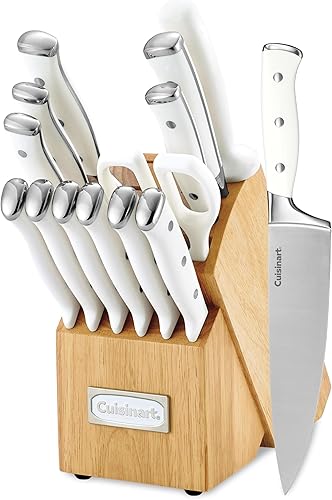 Best for starting from scratch
Cuisinart 15-Piece Forged Triple Rivet Set
9.1/10 our score
See it on Amazon -
2
 Best for lighter knife handling
Cuisinart 15-Piece Hollow Handle Block Set
8.4/10 our score
See it on Amazon -
3
 Best for expanding existing kitchens
imarku 3-Piece Japanese Chef Knife Set
8.2/10 our score
See it on Amazon
- 4
 Check it
Astercook 15-Piece Block Set With Sharpener
Best for frequent bread prep - 5
 Check it
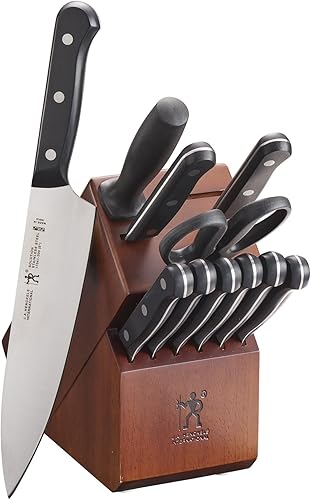
Henckels Solution 12-Piece Set
Best for simple meal routines - 6
 Best for smaller dinner tablesCheck it
What is the best knife set for a home cook?
The Cuisinart Forged Triple Rivet set is the strongest all-around choice for a new household that needs prep knives, table knives and storage together. Choose another set when lighter handling, existing equipment or a dedicated bread knife matters more.
We compared blade roles, construction, handles, storage and maintenance tools. The order favors complete everyday setups, but your best choice depends on which tools you still need.
Read the comparison by function: a larger total doesn't mean more useful cooking knives. Blocks, steels, shears and table knives all contribute to a set's count.
| Product | Best for | Set size | Construction | Storage | Our score |
|---|---|---|---|---|---|
| Cuisinart 15-Piece Forged Triple Rivet Set | starting from scratch | 15 pieces | Forged | Wooden block | 9.1 |
| Cuisinart 15-Piece Hollow Handle Block Set | lighter knife handling | 15 pieces | Forged | Wooden block | 8.4 |
| imarku 3-Piece Japanese Chef Knife Set | expanding existing kitchens | 3 pieces | Separate storage needed | 8.2 | |
| Astercook 15-Piece Block Set With Sharpener | frequent bread prep | 15 pieces | Forged | Hardwood block with built-in sharpener | 8.0 |
| Henckels Solution 12-Piece Set | simple meal routines | 12 pieces | Stamped | 11-slot hardwood block | 7.7 |
| Cuisinart 12-Piece Block Set | smaller dinner tables | 12 pieces | Forged | Black block | 7.5 |
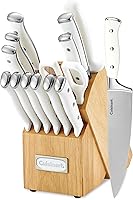
Our top knife set for home cooks: Cuisinart 15-Piece Forged Triple Rivet Set
Cuisinart 15-Piece Forged Triple Rivet Set
- Chef, slicing, santoku, utility and paring knives
- 6 steak knives
- Sharpening steel, shears and wooden block
- Forged full-tang construction
A broad prep selection, table knives and storage make this the first choice for a household building its kitchen knife collection.
Pros
- Several blade shapes for prep
- Includes table knives and maintenance accessories
- Cuisinart provides a lifetime warranty for normal home use
Cons
- Needs a permanent counter spot
- Two paring styles may be unnecessary for basic prep
Choose this Cuisinart if you're replacing a mismatched collection or setting up a kitchen from scratch. Its main advantage is broad coverage in one place, so you can start cooking without choosing each tool separately.
The 8-inch chef knife handles general board work, while the santoku offers another shape for vegetable prep. A slicing knife gives you a longer blade for cooked meat, and the utility knife fills the gap between large and small blades.
Its two paring styles deserve a closer look. The straight paring knife suits small trimming jobs, while the curved bird's beak blade suits peeling and shaping rounded produce.
The forged, full-tang knives have riveted handles and a wide bolster. Cuisinart backs the set against defects in material and workmanship under normal home use throughout the original purchaser's lifetime.
Skip it if you want only a few essentials or already have table knives and storage. Extra blade shapes are useful only when you reach for them, and the block needs a permanent home beside your prep area.
Cuisinart 15-Piece Hollow Handle Block Set
Cuisinart 15-Piece Hollow Handle Block Set
- Chef, slicing, santoku, serrated utility and paring knives
- 6 steak knives
- Sharpening steel, shears and wooden block
- Lightweight design with stainless steel handles
Choose this broad block set if you want lightweight knives and prefer stainless steel handles.
Pros
- Covers prep and table service
- Serrated utility knife adds a different cutting role
- Includes shears and a sharpening steel
Cons
- Requires counter space
- Several prep shapes overlap in daily use
Choose the Hollow Handle set if you want a full countertop collection and lighter knife handling. Cuisinart describes these knives as lightweight, and their stainless steel handles give them a different grip surface from the other handle styles here.
One useful distinction is the serrated utility knife. Its teeth help start cuts through foods with firmer skins and softer centers, such as tomatoes, without relying on downward pressure alone.
The chef knife and santoku overlap for daily chopping, so you can choose the shape that feels more natural for each task. The separate slicing blade suits longer strokes through cooked food.
This set also has two paring styles, which makes more sense for cooks who do detailed produce prep than for someone who mainly chops onions and carrots. The range is broad, but not every kitchen needs every shape.
Skip it if stainless steel handles don't suit your grip preference. Handle material alone can't tell you how a knife will fit your hand, so consider handle shape and your usual grip as well as appearance.
imarku 3-Piece Japanese Chef Knife Set
imarku 3-Piece Japanese Chef Knife Set
- Chef knife, santoku and utility knife
- High carbon stainless steel
- Full-tang pakkawood handles
- Hand wash and towel dry
A focused prep collection suits cooks who already have small-task and bread knives, plus somewhere to store their blades.
Pros
- Adds no countertop block
- Includes two main chopping styles
- Full-tang handles
Cons
- No paring or bread knife
- Storage and maintenance tools must be supplied separately
Choose the imarku trio to expand an existing kitchen without adding another block. It makes the most sense when you already have a paring knife, a serrated bread knife and safe storage.
The chef knife and santoku both cover chopping, slicing and mincing. Having both lets you choose between blade shapes, but it doesn't fill as many distinct roles as a chef, paring and bread knife combination.
The utility knife handles smaller board tasks when a larger blade feels awkward. High carbon stainless steel blades pair with full-tang pakkawood handles, and imarku specifies washing with dish soap followed by towel drying.
Arrange storage before the knives arrive. A suitable drawer insert or individual blade guards keep the edges from hitting utensils and make it safer to reach into a drawer.
Skip this trio as your only kitchen knife collection if you regularly peel produce in hand or slice crusty loaves. It's a focused prep addition, not a complete replacement for every knife role in a household.
Astercook 15-Piece Block Set With Sharpener
Astercook 15-Piece Block Set With Sharpener
- Chef, slicing, santoku, bread, utility and paring knives
- 6 steak knives
- Shears and hardwood block with built-in sharpener
- Black-coated stainless steel blades
A dedicated bread knife makes this a useful full-block choice for households that slice loaves as well as prepare everyday meals.
Pros
- Includes a dedicated serrated bread knife
- Keeps the sharpener with the knives
- Includes table knives and kitchen shears
Cons
- Needs counter room and sharpening access
- Built-in sharpener requires blade-specific care instructions
Choose Astercook if a dedicated bread knife is a priority alongside a broad prep collection. It's the only set here that explicitly includes an 8-inch serrated bread knife, which is useful for slicing full loaves.
A long serrated blade lets you saw through a crust with less need to press down on the soft center. A shorter serrated utility knife serves a different purpose and gives you less blade length for a wide loaf.
The black-coated knives use forged 1.4116 high-carbon German stainless steel and polypropylene handles. Astercook describes the set as dishwasher safe, though careful hand washing remains a simple way to avoid contact with other utensils.
The block's built-in sharpener keeps maintenance equipment nearby. Read Astercook's directions before using it, especially to confirm which blades belong in the sharpener.
Skip it if you expect the block to maintain every edge automatically. A built-in sharpener still needs correct use, and serrated blades require their own care method rather than the same treatment as plain edges.
Henckels Solution 12-Piece Set
Henckels Solution 12-Piece Set
- Chef, paring and serrated utility knives
- 6 steak knives
- Shears, sharpening steel and hardwood block
- Lightweight stamped construction
Three prep knife styles keep the daily choice simple while retaining table knives, storage and common accessories.
Pros
- Clear separation between main prep roles
- Lightweight knives with curved triple-rivet handles
- Includes shears and sharpening steel
Cons
- No dedicated bread knife
- Doesn't include a santoku or slicing knife
Choose Henckels Solution if you want a simple daily knife choice with a block and table knives. Its three prep styles have clear roles: general chopping, small trimming and short serrated cuts.
The 8-inch chef knife does most board work, while the 4-inch paring knife handles smaller jobs. The 5-inch serrated utility knife helps with foods that have a firm outer surface and a soft center.
Its single-piece stamped blades are lightweight, with full tangs and curved triple-rivet handles. That combination suits shoppers who prefer lighter knives and a traditional handle shape.
This is a better fit for straightforward weeknight meals than for someone seeking several specialized prep blades. You can make a full meal with a small range of knives when their roles match the food you're preparing.
Skip it if you specifically want a santoku, a slicing knife or a full-length bread knife included. Those gaps matter more than the set's smaller total, particularly if bread or carving features often in your meals.
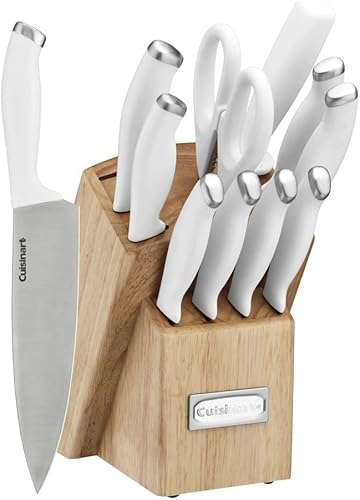
Cuisinart 12-Piece Block Set
Cuisinart 12-Piece Block Set
- Chef, slicing, santoku, utility and paring knives
- 4 steak knives
- Sharpening steel, shears and black block
- High carbon stainless steel blades
A broad prep selection with fewer table knives suits households that usually serve up to four people.
Pros
- Multiple prep blade styles
- Includes maintenance steel and shears
- Cuisinart backs it with a lifetime warranty against defects
Cons
- Larger dinner groups need extra steak knives
- Prep knives still have some overlapping roles
Choose this Cuisinart for varied prep and a smaller dinner table. It keeps several kitchen blade styles while including four steak knives, making it a sensible fit for households that rarely need a larger table set.
Unlike the Henckels option, this set includes both a santoku and a slicing knife. That gives you more choice during prep without adding another pair of table knives you may seldom use.
The knives have high carbon stainless steel blades, white contoured plastic handles and a black storage block. Cuisinart provides a lifetime warranty against defects in material and workmanship.
Think about how you cook rather than treating this as a smaller version of every larger set. It still has overlapping chopping options, so a lower piece count doesn't automatically make it a minimalist collection.
Skip it if you often serve more than four people who need steak knives. Also choose another arrangement if a dedicated bread blade is essential, since that role isn't included in this set.
How do you choose a knife set for home cooking?
Choose by cutting tasks, handle fit and storage space, then use piece count as a final check. The right set should cover your meals without forcing you to keep tools you already own or won't use.
Which knives matter most in a home cook's set?
Start with a chef knife, a paring knife and a serrated blade suited to what you cut. These cover large board tasks, small trimming jobs and foods that benefit from a sawing cut.
A chef knife handles onions, herbs, vegetables and boneless meat. A paring knife offers a short blade for removing blemishes, trimming stems and other small jobs where a large knife gets in the way.
For regular bread slicing, look for a dedicated bread knife rather than assuming any serrated blade is equivalent. A short serrated utility knife is useful for smaller foods but limits the stroke you can use across a large loaf.
A santoku is an alternative main prep shape, not a requirement alongside a chef knife. A slicing knife earns its place if you often portion roasts or want long, smooth cuts through cooked food.
Use our guide to the knives you need in a knife set to match those roles to your menu. Keep the knives you already use well in that calculation.
How should you judge piece counts?
Count useful roles before total pieces. Six steak knives support dinner service, but they don't give you six more ways to prepare vegetables.
Write down what you already own, including shears, sharpening tools and storage. A full set becomes less appealing when several accessories duplicate equipment that still works.
Avoid assuming a shared piece count means identical contents. Compare the named knives, especially the difference between a serrated utility blade and a bread knife.
Do you want a block or separate storage?
Choose a block when you have a fixed counter spot that leaves enough room for a cutting board. Choose separate storage when keeping the work surface clear matters more than displaying the collection.
Allow room above the block to withdraw its longest knife. A block that fits beneath a cabinet may still be awkward to use if the knife handle or blade hits the cabinet as you lift it.
Place it within easy reach of the prep area, away from splashing water and the counter edge. A drawer insert needs enough depth and clearance for both blades and handles.
Our guide to knife block sets explains storage layouts. For a wider look at blade styles and construction, browse the kitchen guides and basics.
Does forged or stamped construction matter?
Use construction as one part of the choice, alongside weight, handle shape and blade roles. It doesn't replace checking whether the set includes the knives your cooking needs.
Forged blades are shaped from heated metal, while stamped blades are cut from steel sheet. The finished knife's design also affects its weight and balance, so the construction label alone doesn't settle comfort.
A full tang describes how far the blade's metal extends into the handle. It doesn't tell you whether the handle is too large, too narrow or shaped well for your grip.
Our guide to forged vs stamped knives explains the terms. Prioritize a knife you can control comfortably over a construction label you won't notice during dinner prep.
How can you judge handle comfort?
Look for a secure grip without squeezing hard. Your fingers need room around the handle, and your knuckles need clearance above the cutting board during chopping.
If you can hold a knife before committing, use your normal cutting grip with dry hands. Check for pressure points where your fingers meet the bolster or handle edges.
A pinch grip places the thumb and index finger on opposite sides of the blade near the handle, with the remaining fingers around the handle. Don't force that grip if the knife's shape makes it uncomfortable.
How should you set up and use a new knife set?
Set up a stable board and safe storage first, then learn the main knife before using every extra blade. A steady work area gives you more control than trying to cut quickly.
Start with a stable cutting surface
Use a wood or suitable plastic cutting board with enough room for the food and your knife stroke. Glass, stone and ceramic cutting surfaces are hard on knife edges.
Place a damp cloth or suitable nonslip mat beneath a board that slides. Dry your hands and the knife handle before cutting.
For round produce, make a flat side when practical, then rest that side on the board. Keep the fingertips of your guiding hand curled back from the edge.
Match the blade to the task
Use controlled slicing or chopping motions rather than forcing a knife straight through resistant food. A plain-edge knife that slips on tomato skin or crushes soft produce may need edge maintenance.
Use a serrated blade with a sawing motion. Avoid twisting a thin kitchen blade inside food, prying open packaging or using the tip as a screwdriver.
These sets are for normal kitchen cutting, not chopping through bones or forcing apart frozen food. Let frozen ingredients thaw enough for safe cutting, and use tools designed for tougher jobs when needed.
Keep the work area clear
Place a knife flat on the board in a visible spot when you pause. Don't hide it beneath food scraps, towels or dishes.
Move chopped food with a scraper or the spine of the knife rather than dragging the cutting edge sideways across the board. If a knife falls, step back and let it land.
What should you check about sharpening and care?
Plan for cleaning, honing and eventual sharpening before the edges become difficult to use. An included steel or sharpener is useful only when you know which blades it suits and how to use it.
Understand what the included tools do
A conventional honing steel mainly helps straighten a slightly rolled edge. Sharpening removes metal to form a new edge, so honing won't restore every dull blade.
The tool names in knife sets can blur that difference. Follow the brand's directions for the actual steel or sharpener rather than treating all maintenance tools as interchangeable.
Use light, controlled strokes at the recommended angle. More force isn't a shortcut to a better edge, and serrated knives shouldn't go through an ordinary plain-edge sharpener unless the instructions permit it.
Our knife care and sharpening guide covers routine maintenance. For the included tools specifically, read how to sharpen knives in a knife block.
Wash, dry and store each knife
Hand wash knives individually with dish soap, keeping the edge directed away from your fingers. Don't leave them loose in a sink or hidden in cloudy water.
Dry the blade and handle promptly, then return the knife to protected storage. Stainless steel still benefits from prompt cleaning, especially after contact with acidic or salty foods.
Follow brand-specific care directions even when your preferred routine differs. Avoid abrasive scrubbers on coated blades unless the brand's instructions allow them.
Keep the block dry and clean
Put only clean, dry knives into a block. Wet blades carry moisture into slots that are harder to reach than an open drawer tray.
Remove crumbs and clean the block using a method suited to its material. Our guide to how to clean a knife block explains how to care for the storage as well as the blades.
Which knife-set buying mistakes should you avoid?
Avoid buying duplicates, overlooking missing roles and skipping the storage plan. These mistakes can leave you with a large collection that still doesn't cover your meals.
- Choosing by total pieces: Separate prep knives from table knives and accessories before comparing sets.
- Assuming small means complete: A three-knife collection can still lack the paring or bread knife you use most.
- Treating every serrated blade as a bread knife: Blade length matters when you're cutting a wide loaf.
- Buying for occasional guests alone: Choose prep tools for your normal routine, then decide how to handle extra table settings.
- Ignoring cabinet clearance: Check that you can withdraw the longest knife, not just fit the block beneath a shelf.
- Expecting a warranty to replace care: Coverage for defects doesn't remove the need to clean, dry and maintain an edge.
Also resist replacing every knife because one blade needs attention. If the rest of your collection works well, a single replacement or sharpening service may solve the actual problem.
Which knife set should you choose for your home?
Choose the best knife set for your home cooking by filling the gaps in your current kitchen. Buy a broad block set when you need the whole setup; choose a focused collection when storage and supporting knives are already covered.
Pick the Cuisinart Forged Triple Rivet set for a new household that wants varied prep tools and table service together. Choose the Hollow Handle version when lighter handling and stainless steel handles are your priorities.
Pick imarku to add main prep blades to an equipped kitchen. Choose Astercook if regular bread slicing makes a dedicated bread knife worth having in the block.
Choose Henckels Solution for simple meals and fewer prep styles to sort through. Pick the Cuisinart 12-piece set when varied prep matters but four table knives meet your usual dinner needs.
Before ordering, settle where the knives will live and which blade you'll use for your most common meal. The complete knife block set guide can help you make that final storage choice.
About this guide: KittedWell compares knife sets for home cooks by included knives, construction, storage and care instructions.
Our top 3 picks at a glance
-
1
Best for starting from scratch
Cuisinart 15-Piece Forged Triple Rivet Set
9.1/10 our score
See it on Amazon -
2
Best for lighter knife handling
Cuisinart 15-Piece Hollow Handle Block Set
8.4/10 our score
See it on Amazon -
3
Best for expanding existing kitchens
imarku 3-Piece Japanese Chef Knife Set
8.2/10 our score
See it on Amazon
Frequently asked questions
What knives does a home cook need?
Most home cooks need a chef knife for board work, a paring knife for small tasks and a serrated knife for bread or delicate skins. Add other shapes when they solve a regular task.
Our guide to what knives you need in a knife set explains those roles.
Is a 15-piece knife set too much for a home cook?
A 15-piece set makes sense when you need table knives, storage and accessories as well as prep blades. Count the tools you'll use rather than choosing by the total.
If you already have steak knives and storage, a smaller collection can avoid duplicates and leave more room for food prep.
Should I choose a knife block set or separate knives?
Choose a block set when you need a coordinated group of knives and have a permanent counter spot for storage. Choose separate knives when you want to replace specific tools or keep only a few blades.
Our knife block set buying guide explains the storage tradeoffs before you commit.
How should I care for kitchen knives?
Wash knives individually, dry them promptly and store their edges away from loose utensils. Follow each brand's directions for cleaning and sharpening, particularly for coated or serrated blades. imarku specifies hand washing and towel drying.
Our knife care and sharpening guide covers the habits that support a regular maintenance routine.